How does smart urban planning shape the future of sustainable cities?
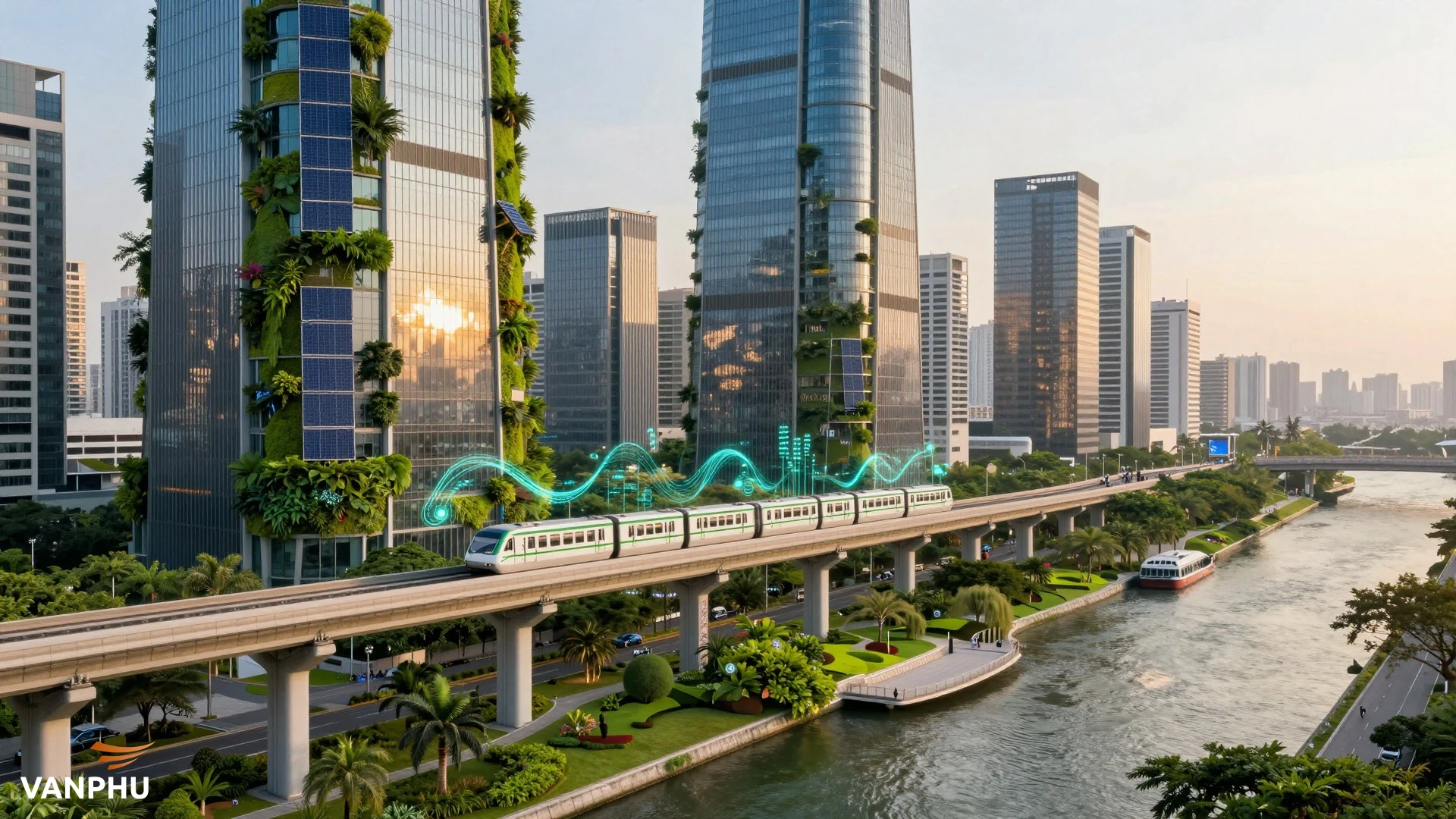
Smart urban planning represents the next frontier in human settlement. It integrates technology, data, and sustainable design to solve modern challenges. As global populations shift toward urban centers, the need for efficient management grows. Experts predict that nearly 70% of the world's population will live in cities by 2050 [1]. This massive migration creates immense pressure on infrastructure, energy, and environment.
In Vietnam, the government recognizes this urgent necessity. Decision 950/QD-TTg, issued in 2018, set the initial foundation for smart city development [1]. However, the journey from traditional planning to a "smart" reality involves complex legal and technical steps. Recent regulations, such as Decree 269/2025/ND-CP, provide a clearer roadmap for local authorities [2]. This article explores how these planning strategies transform our urban landscapes.

What is the historical context of urban development through industrial revolutions?
Urbanization has always followed the trajectory of technological breakthroughs. To understand smart cities, we must look at the four industrial revolutions. Each wave of innovation fundamentally altered how we build and manage our living spaces [1]. These shifts moved cities from small, localized hubs to massive, interconnected networks.
How did the first industrial revolution change city boundaries?
The first industrial revolution introduced the steam engine. This invention allowed factories to move away from water sources and raw material sites. Consequently, cities began to expand beyond their traditional geographic limits. Steam-powered transportation, like trains, facilitated horizontal urban growth. This era marked the beginning of large-scale urban migration as people sought factory jobs [1].
Why did the second industrial revolution lead to mass production and sprawl?
The second industrial revolution brought electricity and mass production. These advancements allowed for even greater urban density and productivity. Automated engines and assembly lines increased output significantly. As production grew, so did the physical footprint of cities. Urban areas became centers of industry, but they also faced early challenges with pollution and overcrowding [1].
Why is smart urban planning essential in the era of Industry 4.0?
We are currently living through the fourth industrial revolution (Industry 4.0). This era is defined by the fusion of physical, digital, and biological spheres. Technologies like the Internet of Things (IoT), Artificial Intelligence (AI), and Big Data are the new building blocks. These tools allow planners to move beyond static maps to dynamic, responsive systems [5].
Smart planning is no longer just about adding "smart" gadgets to a city. It is about creating a foundational platform for integrated management. Traditional planning often operates in silos, where transport, water, and energy are managed separately. Industry 4.0 breaks these barriers. It enables a holistic view of urban health and efficiency [1].
How does the digital revolution impact modern urban management?
The digital revolution provides unprecedented access to real-time data. In the past, planners relied on historical surveys that were often outdated. Today, sensors and mobile devices provide constant feedback on city operations. This data allows for "predictive" planning rather than "reactive" planning. For example, cities can adjust traffic signals in real-time to prevent congestion before it happens [5].
What role does the Internet of Things play in urban connectivity?
The Internet of Things (IoT) acts as the nervous system of a smart city. It connects millions of devices, from streetlights to trash bins, to a central network. This connectivity allows for massive energy savings and improved public services. In Vietnam, many provinces are now adopting IoT to monitor air quality and water levels. These small sensors provide the data needed for large-scale planning decisions [5].
What are the core pillars of Vietnam's smart city strategy?
Vietnam has established a clear legal framework to guide its urban transformation. The strategy focuses on three main pillars: smart planning, smart management, and smart utilities [1]. Among these, smart urban planning is considered the vital foundation. Without a smart plan, utilities and management systems cannot function effectively.
How does Decision 950/QD-TTg define the roadmap for urban growth?
Decision 950/QD-TTg, approved in 2018, was a landmark policy for Vietnam. It outlined the vision for sustainable smart city development through 2025 and 2030. The decision emphasizes the need for a synchronized approach across all levels of government. It also encourages the use of advanced technologies to solve urban issues like traffic jams and environmental pollution [5].
What are the new requirements under Decree 269/2025/ND-CP?
Decree 269/2025/ND-CP, issued on October 14, 2025, introduces stricter and more detailed requirements. It mandates that provincial and city development schemes must analyze current challenges in both the short and long term [2]. Planners must now define clear "maturity levels" for their smart city goals. This ensures that development is measurable and accountable rather than just theoretical.
The decree also requires the identification of priority projects. These projects can be funded by the state budget or through public-private partnerships (PPP). By diversifying funding sources, the government aims to accelerate the pace of smart development. Furthermore, the decree emphasizes the need to avoid overlap with existing digital transformation programs [2].
How can local governments implement effective smart planning schemes?
Implementation is often the most difficult phase of urban development. Local governments must move from high-level visions to actionable technical plans. This requires a deep understanding of local geography, demographics, and infrastructure. Decree 269/2025/ND-CP provides a structured approach for this process [2].
What analysis is required for a provincial smart development scheme?
A successful scheme begins with a comprehensive situation analysis. Planners must evaluate existing infrastructure and identify gaps in service delivery. They must also consider inter-disciplinary management issues. This means looking at how transport affects housing, and how energy use impacts the environment. The goal is to create an integrated system where all parts work together [2].
How should cities integrate digital transformation with urban planning?
Digital transformation and urban planning must be treated as two sides of the same coin. Smart planning is not just about physical buildings; it is about the digital layers that support them. Cities must establish digital infrastructure, such as 5G networks and data centers, alongside traditional roads and bridges. This integration ensures that the city is "future-proof" and ready for new technological waves [3].
In the private sector, reputable developers like Văn Phú are already adopting smart infrastructure to enhance the living standards of urban residents. By aligning with national standards, these developers help bridge the gap between government policy and practical application. This collaboration is essential for creating cohesive smart districts within larger cities.
What technologies drive the success of smart urban planning?
Technology acts as the enabler for all smart planning initiatives. Without the right tools, data remains raw and unusable. Several key technologies have emerged as essential for modern planners. These tools help visualize complex data and simulate the impact of planning decisions before they are implemented.
Why is the City Information Model (CIM) crucial for decision-making?
The City Information Model (CIM) is a revolutionary tool for urban management. It creates a "digital twin" of the entire city. According to Article 10 of Decree 269/2025/ND-CP, CIM is mandatory for evaluating multi-dimensional impacts [3]. It allows planners to analyze how a new building might affect wind patterns, sunlight, or traffic flow. This data-driven approach reduces errors and optimizes land use.
How do Big Data and AI optimize urban resource management?
Big Data and AI are the "brain" of the smart city. They process millions of data points from sensors, cameras, and social media. AI algorithms can then identify patterns that are invisible to the human eye. For instance, AI can optimize energy distribution in a grid based on real-time demand. This reduces waste and lowers costs for the city and its residents [5]. Understanding why market data analysis is the cornerstone of modern investment success can also help planners attract the right businesses to smart zones.
What lessons can Vietnam learn from international smart city models?
Vietnam is not alone in its quest for smart urbanization. Many countries have already faced these challenges and developed unique solutions. By studying international experiences, Vietnam can avoid common pitfalls and adopt best practices. This comparative approach is vital for building a robust legal and technical framework.
Why is China's legal framework on data security a relevant reference?
China is a global leader in the number of smart city projects. Their approach focuses heavily on a multi-layered legal ecosystem. This includes laws on cybersecurity, data security, and personal information protection [4]. For Vietnam, China's model offers valuable lessons on how to balance innovation with national security. Protecting "data sovereignty" is a critical concern when city operations rely entirely on digital networks [4].
How do European cities like Amsterdam lead in smart innovation?
European cities often focus on sustainability and citizen engagement. Amsterdam and Barcelona have successfully implemented smart solutions to reduce CO2 emissions and improve mobility [5]. These cities prioritize "smart people" alongside "smart technology." They use open-data platforms to encourage citizens to develop their own apps and solutions. This bottom-up approach ensures that technology serves the actual needs of the people.
What are the common challenges in building smart cities today?
Despite the clear benefits, building a smart city is fraught with difficulties. The transition requires significant financial investment and a change in mindset. Many projects fail because they focus too much on technology and not enough on the people who use it. Identifying these challenges early is the first step toward overcoming them.
Why is data privacy a major concern for urban planners?
As cities collect more data, the risk of privacy breaches increases. Smart cities rely on cameras and sensors that track movement and behavior. Residents are often concerned about how this data is stored and who has access to it. Research on international law suggests that strong data protection laws are essential for public trust [4]. Without trust, citizens may resist the implementation of smart technologies.
How can cities overcome the lack of synchronized legal corridors?
One of the biggest hurdles in Vietnam is the lack of a unified legal framework. Different ministries often have overlapping or conflicting regulations. Decree 269/2025/ND-CP aims to solve this by providing a centralized set of rules for smart planning [2]. However, local authorities still need clear guidance on how to apply these rules in practice. Continuous legal reform and capacity building for officials are necessary to ensure smooth implementation.
How does smart planning improve the quality of life for residents?
At its core, smart urban planning is about making life better. It aims to reduce the daily stresses of city living, such as long commutes and poor air quality. When a city is planned "smartly," its residents enjoy more free time and a healthier environment. This human-centric approach is the ultimate goal of all urban development.
What are the benefits of smart transportation and energy systems?
Smart transportation systems can reduce travel times by up to 20%. By using real-time data to manage traffic and public transit, cities can make commuting much more efficient. Similarly, smart energy grids can lower utility bills by optimizing power distribution. These systems also support the transition to renewable energy, which is crucial for fighting climate change [5].
How can smart apartments 4.0 redefine modern living standards?
The concept of the "smart city" extends into the home. Modern residential developments are now integrating IoT and AI to create "smart apartments." These homes offer automated climate control, enhanced security, and energy-saving features. Discovering what defines a smart apartment 4.0 in today's digital landscape helps residents understand the value of these innovations. These buildings serve as the micro-units that make up the larger smart city ecosystem.
What is the future outlook for smart urban development by 2050?
The future of cities is undeniably smart. By 2050, the majority of the global population will reside in urban areas [5]. These cities will need to be self-sustaining, efficient, and resilient. Smart urban planning provides the framework to achieve this vision. It allows us to build cities that are not just bigger, but better.
In Vietnam, the progress is already visible. With 28 localities having issued smart city plans and 11 having established ICT architectures, the momentum is growing [5]. The focus will now shift toward deeper integration and the use of "Digital Twins" for long-term management. As technology continues to evolve, our cities will become even more responsive to the needs of their inhabitants.
Ultimately, the success of smart urban planning depends on collaboration. Government, private developers, and citizens must work together to build the cities of tomorrow. By following the roadmap laid out in Decree 269/2025/ND-CP and embracing Industry 4.0, Vietnam is well-positioned to lead the way in sustainable urban growth.
More Information
- Smart Urban Planning [1]: A method of city design that uses digital technology and data analysis to improve infrastructure, services, and sustainability for residents.
- Decree 269/2025/ND-CP [2]: A Vietnamese government regulation that provides detailed requirements for the development, management, and implementation of smart city schemes at provincial and city levels.
- City Information Model (CIM) [3]: A 3D digital representation of a city's physical and functional characteristics, used for simulation, impact analysis, and decision-making in urban planning.
- Data Sovereignty [4]: The concept that data is subject to the laws and governance structures of the nation where it is collected or processed, particularly regarding security.
- Industry 4.0 [5]: The fourth industrial revolution characterized by the integration of digital technologies like AI, IoT, and Big Data into physical production and urban management.