Unlocking Tomorrow: Exploring the Transformative Power of Future Technology
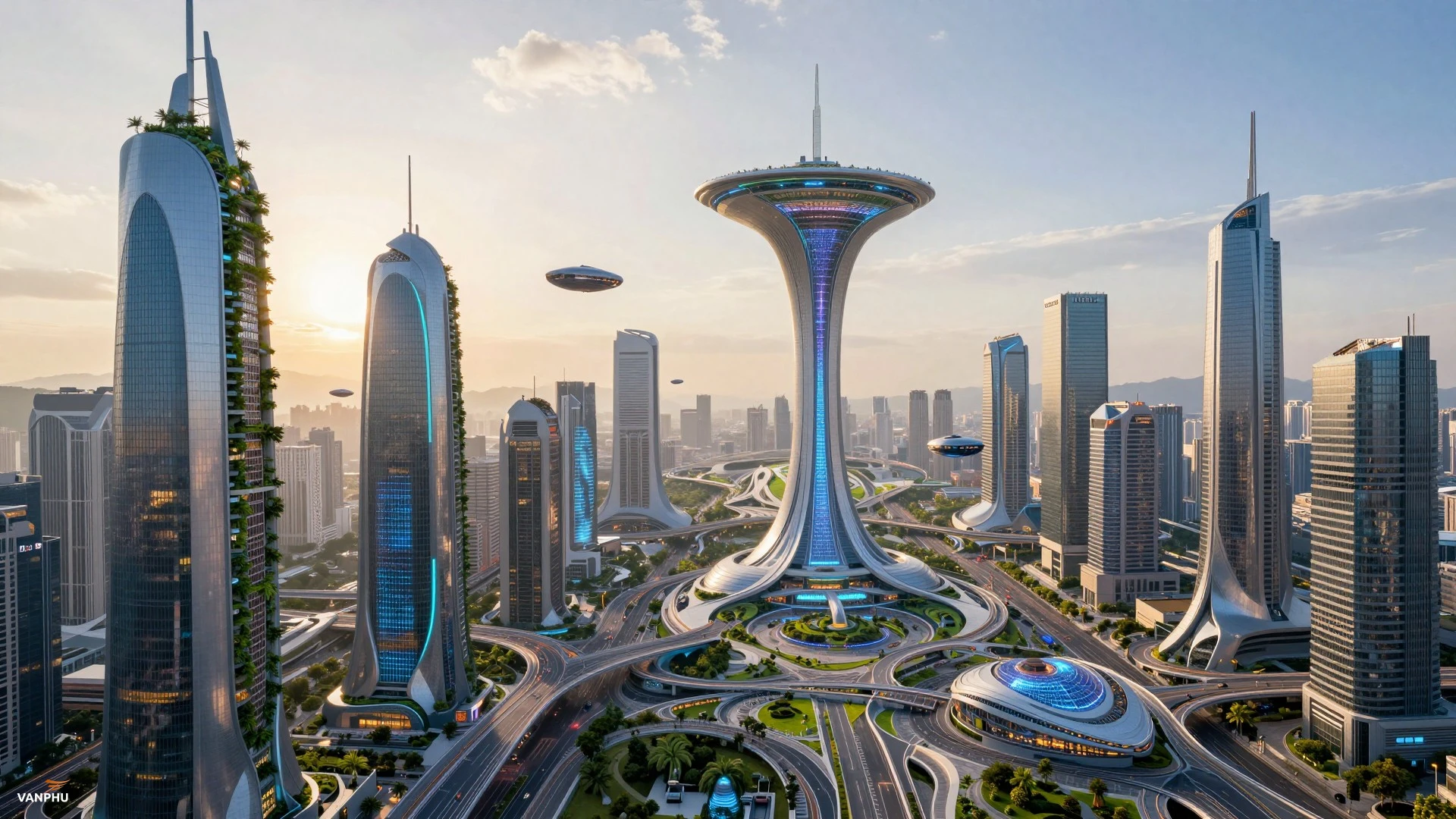
Technology continues to redefine human existence. It permeates every facet of our lives. The recent global challenges, like the COVID-19 pandemic, underscored its strategic importance. Technology helped individuals and businesses adapt quickly and achieve breakthroughs [1]. So, what are these groundbreaking technologies? Let’s explore the current trends and upcoming innovations shaping our future.
The Dawn of Artificial Intelligence and Machine Learning
Artificial Intelligence (AI) simulates human thought and learning processes in machines [1]. Unlike traditional logic programming, AI systems can reason, make decisions, and even learn autonomously. This field has delivered many surprises recently. AI powers image and voice recognition, navigation apps, and personal assistants on smartphones [1].
Machine Learning (ML) is a subset of AI. It allows computers to improve themselves based on data or experience [1]. ML excels at prediction tasks, like forecasting housing prices. It also performs classification, such as handwriting recognition. By 2030, AI is expected to achieve exponential improvements. This includes processing power, voice recognition, and deep learning algorithms [2].

Natural Language Processing (NLP) technologies, like advanced language models, are constantly evolving [2]. Many believe AI could soon pass the Turing Test. This test assesses a machine’s ability to exhibit intelligent behavior indistinguishable from a human [2]. This progress could lead to nuanced virtual assistants and realistic characters in virtual worlds. Furthermore, AI is a major trend for 2024. It drives automation, personalization, and creative enhancement [5].
Cloud Computing: The Backbone of Digital Transformation
Cloud computing is increasingly popular across many industries. The term “Cloud” refers to the internet itself. It represents a remote storage and access point for software and databases [1]. Data stored in the Cloud resides on virtual servers. This eliminates the need for local storage. Cloud technology provides flexibility and scalability for businesses worldwide.
The Cloud is a critical component of the AI ecosystem. It provides the infrastructure for processing vast amounts of data. Major players in the industry are building “AI factories.” These are data centers optimized for AI, integrating GPUs, networks, and software [3]. Therefore, Cloud computing enables the widespread adoption and development of advanced AI applications.
The Internet of Things (IoT): Connecting Our World
The Internet of Things (IoT) creates a vast network of interconnected devices. Businesses use IoT to share data and information in real-time [4]. The global IoT market was valued at over $260 billion in 2021. This rapid growth suggests a huge increase in IoT data volume [4]. IoT data could exceed 79 zettabytes by 2025.
IoT connects everything, from home appliances to industrial machinery. It enables automation and remote control [5]. Real-time data on user behavior, machine status, and environmental conditions becomes available. This data is invaluable for analysis and optimization across many sectors [5]. The combination of AI, ML, and IoT will drive significant breakthroughs. These technologies will integrate into every aspect of life, serving human needs [1].
Immersive Realities: Virtual and Augmented
Virtual Reality (VR) and Augmented Reality (AR) are transforming how we interact with digital content. VR completely immerses users in a simulated environment. AR overlays digital information onto the real world. By 2030, most VR displays will feature 8K resolution [2]. This is four times the pixels of 4K screens. This advancement will offer spectacular detail and realism. VR games will also have near-zero latency and wide fields of view [2].
These technologies have applications beyond gaming. They are used in training simulations, design, and even remote work. Some haptic suits will also become common. These suits enhance immersion by providing tactile feedback [2]. Consequently, VR and AR will reshape entertainment, education, and professional fields. Learn more about these top technologies and their future impact.
Blockchain: Securing Digital Interactions
Blockchain technology offers a decentralized and secure way to record transactions. It creates an immutable ledger that is transparent and resistant to tampering. While often associated with cryptocurrencies, Blockchain has broader applications. It can enhance supply chain management, digital identity verification, and data security. Its distributed nature makes it highly resilient. This technology is crucial for building trust in digital ecosystems. Furthermore, its integration with AI and IoT promises even more secure and efficient systems.
Bioengineering and Advanced Computing Power
Bioengineering is an exciting field. It applies engineering principles to biological systems. Researchers are developing new treatments, diagnostics, and even artificial organs. This area holds immense potential for healthcare and human longevity. Meanwhile, computing power continues to advance rapidly. This exponential growth underpins all other technological progress [4]. Faster processors and more efficient algorithms enable complex AI models and massive data analysis. Unlocking tomorrow: exploring the transformative power of future technology is a continuous journey.
The Interconnected Ecosystem of Innovation
Future technology is not about isolated advancements. It is about the synergy between different fields. AI, IoT, and Big Data form a powerful trio [5]. AI provides intelligence, IoT gathers data, and Big Data processes it. This creates a feedback loop for continuous improvement. For instance, smart homes use IoT sensors. AI analyzes this data to optimize energy usage and security. In the automotive sector, self-driving cars rely on AI, IoT, and advanced computing. These cars process vast amounts of real-time data to navigate safely.
The GTC 2026 event highlighted this interconnectedness [3]. It showcased an AI ecosystem where hardware, software, cloud, data, and applications collaborate. Companies like Intel and NVIDIA are crucial. They provide the foundational chips and infrastructure [3]. This collaborative environment fosters rapid innovation. It ensures that advancements in one area benefit many others. The entire AI industry is now a collaborative playground.
Impact on Industries and Daily Life
Future technology will profoundly impact various sectors. In healthcare, AI assists with diagnostics and personalized treatment plans [4]. It helps identify the most suitable therapies for patients. Smart cities will leverage IoT for efficient resource management and improved public services. Autonomous vehicles will transform transportation. They promise safer roads and reduced traffic congestion. By 2030, one in ten cars could be self-driving [5].
The workforce will also see significant changes. Automation will handle repetitive tasks. This allows humans to focus on creative and strategic work. The demand for skilled professionals in AI, IoT, and Big Data is surging [5]. Businesses are adopting AI to boost production efficiency and personalize customer experiences [5]. This digital transformation requires continuous learning and adaptation. EON Tech is a leader in applying these innovations to real-world business challenges.
Navigating Challenges and Ethical Considerations
While the benefits are immense, future technology also presents challenges. Data privacy and security are paramount. The ethical implications of advanced AI, such as bias and accountability, require careful consideration. Furthermore, the digital divide could widen if access to these technologies is not equitable. Therefore, responsible development and regulation are essential. We must ensure that these advancements benefit all of humanity. Future technology: shaping our world and beyond depends on thoughtful implementation.
Conclusion: Embracing a Technologically Advanced Future
The landscape of future technology is dynamic and full of promise. From human-like AI to immersive realities and interconnected devices, these innovations are reshaping our world. They offer unprecedented opportunities for progress and problem-solving. Businesses and individuals must stay informed and adapt to these rapid changes. Embracing these technologies will unlock new possibilities. It will drive efficiency, enhance experiences, and improve quality of life. The journey into tomorrow’s technology is an exciting one. It promises a future more connected, intelligent, and transformative than ever before. Discover more about these potential trends and their impact.
More Information
- Artificial Intelligence (AI): A field of computer science focused on creating machines capable of performing tasks that typically require human intelligence, such as learning, problem-solving, and decision-making.
- Machine Learning (ML): A subset of AI that enables systems to learn from data, identify patterns, and make decisions with minimal human intervention, improving performance over time.
- Internet of Things (IoT): A network of interconnected physical devices, vehicles, home appliances, and other items embedded with sensors, software, and other technologies that allow them to connect and exchange data.
- Virtual Reality (VR): A simulated experience that can be similar to or completely different from the real world, typically achieved through head-mounted displays that provide immersive visual and auditory feedback.
- Augmented Reality (AR): An interactive experience of a real-world environment where the objects that reside in the real world are enhanced by computer-generated perceptual information, sometimes across multiple sensory modalities.